As architects, we are often tempted to believe that complexity makes a design more impressive. Experience has taught me the opposite. The buildings that endure are seldom the most complicated. They are the ones where every line has a purpose, every space serves a function, and every decision contributes to the whole.
The same principle applies to life.
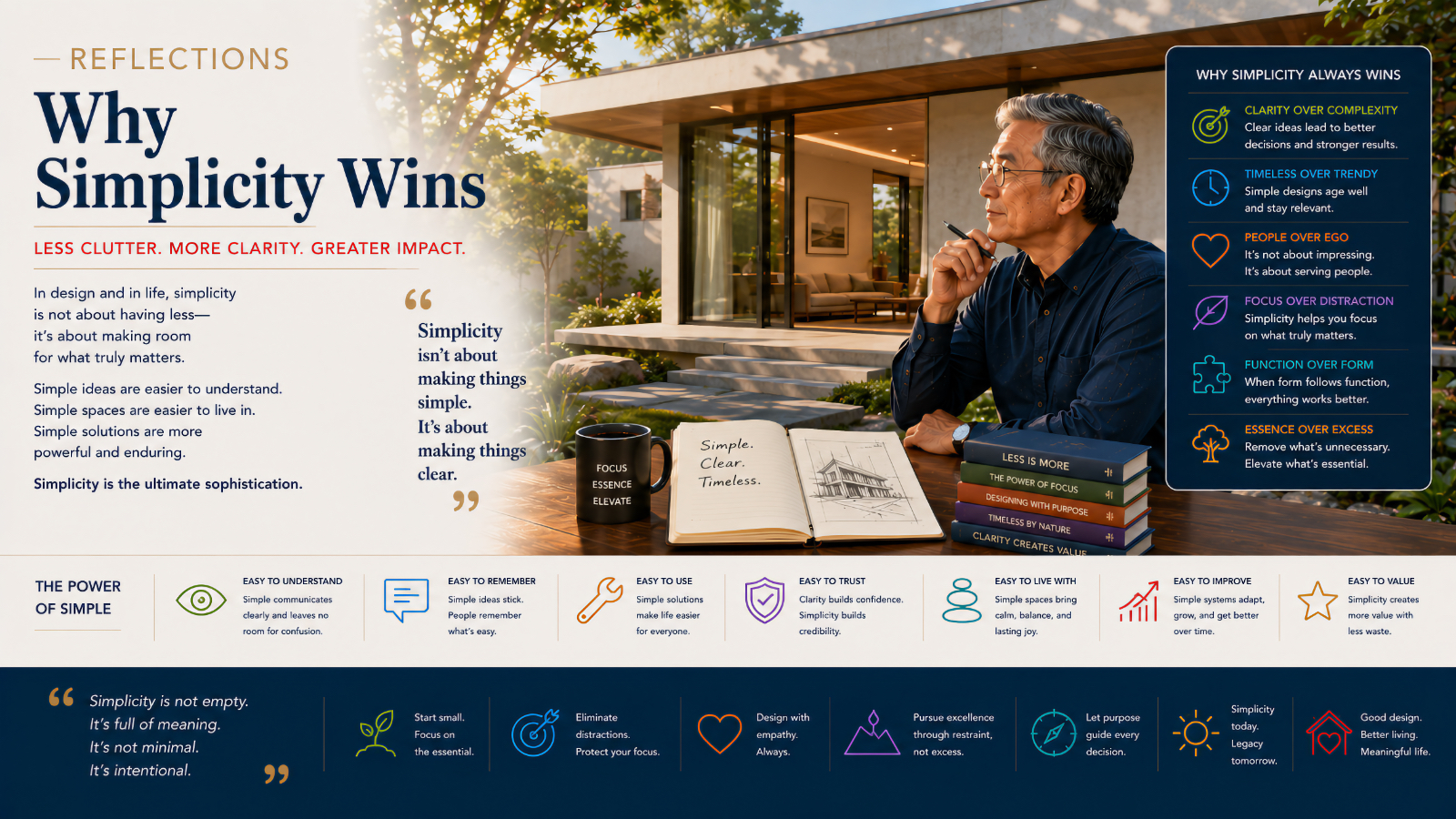
Simplicity is not about having less merely for the sake of minimalism. It is about making room for what truly matters. It is choosing clarity over confusion, purpose over distraction, and lasting value over temporary trends.
Over the years, I have come to believe that simplicity is not the absence of thought—it is the result of thoughtful decisions.
Why Simple Architectural Design Creates Better Living Spaces
One lesson that every architect eventually learns is that the simplest solution is often the strongest.
Simple spaces are easier to understand. They feel comfortable because circulation is natural, proportions are balanced, and every room serves a clear purpose. People instinctively know how to move through them because nothing feels forced or unnecessary.
This simplicity is not accidental. It requires discipline to remove distractions while preserving everything that is essential.
As Leonardo da Vinci famously observed, "Simplicity is the ultimate sophistication." I have found that to be true throughout my professional life.
Choosing Clarity Over Complexity in Everyday Decisions
Complicated ideas often create complicated outcomes.
Whether presenting a design to clients or making important life decisions, clarity produces confidence. When people understand the reasoning behind a decision, trust naturally follows.
Simple communication leaves little room for misunderstanding. It allows everyone—clients, consultants, contractors, and builders—to move together toward the same objective.
Clarity is not merely about speaking plainly. It is about thinking clearly first.
Better thinking almost always produces better results.
Why Timeless Design Outlasts Passing Trends
Architecture is filled with changing fashions.
One decade favors one style, while the next embraces something entirely different. Yet many of the world's most admired buildings remain beautiful because they were designed with timeless principles rather than temporary trends.
The same philosophy has guided my own practice.
Rather than chasing what is fashionable today, I have always preferred designs that will still feel relevant many years from now. Good proportions, honest materials, natural light, and thoughtful planning never go out of style.
Timeless design grows more valuable with age.
Putting People Before Personal Ego
Architecture should never become an exercise in self-expression alone.
Clients do not hire architects to admire the architect's creativity. They entrust us with creating spaces that improve their daily lives.
That means listening carefully, understanding their needs, respecting their budget, and finding solutions that genuinely serve them.
People should always come before personal ego.
The buildings I remember most fondly are not necessarily the most elaborate ones. They are the projects where families flourished, businesses succeeded, and communities benefited because the design fulfilled its purpose.
Designing with Focus Instead of Distraction
Modern life constantly competes for our attention.
The same is true in architecture. Every project offers endless possibilities, but not every idea deserves to remain.
Good design often comes from knowing what to remove rather than what to add.
When distractions disappear, the essential qualities of a building become stronger. Form begins to support function naturally. Materials speak honestly. Spaces feel calmer and easier to enjoy.
Simplicity allows people to focus on what truly matters.
Function Before Form Creates Better Architecture
Beautiful buildings should also work beautifully.
A home should be easy to live in.
An office should support productivity.
A hotel should make guests feel welcome and comfortable.
When form follows function, everything works together harmoniously. Beauty emerges naturally because every design element has a reason for being there.
This philosophy has influenced many of my own projects throughout the years.
Removing the Unnecessary Reveals What Matters Most
One of the greatest lessons life has taught me is that more is not always better.
Removing unnecessary complexity creates space for excellence.
Whether organizing an office, preparing architectural drawings, writing an article, or simply living each day, simplicity reduces waste, improves focus, and makes continual improvement easier.
Simple systems are easier to maintain.
Simple ideas are easier to remember.
Simple spaces are easier to enjoy.
Most importantly, simple lives leave room for the relationships, experiences, and values that truly define happiness.
Simplicity is not empty.
It is full of meaning.
It is not minimal for its own sake.
It is intentional.
As both an architect and a student of life, I have found that the clearest solutions are often the most enduring. Good design is not about adding more—it is about discovering what is essential, protecting it, and allowing it to speak with quiet confidence. In architecture, as in life, simplicity creates clarity, clarity builds trust, and trust leaves a legacy that lasts far longer than complexity ever can.