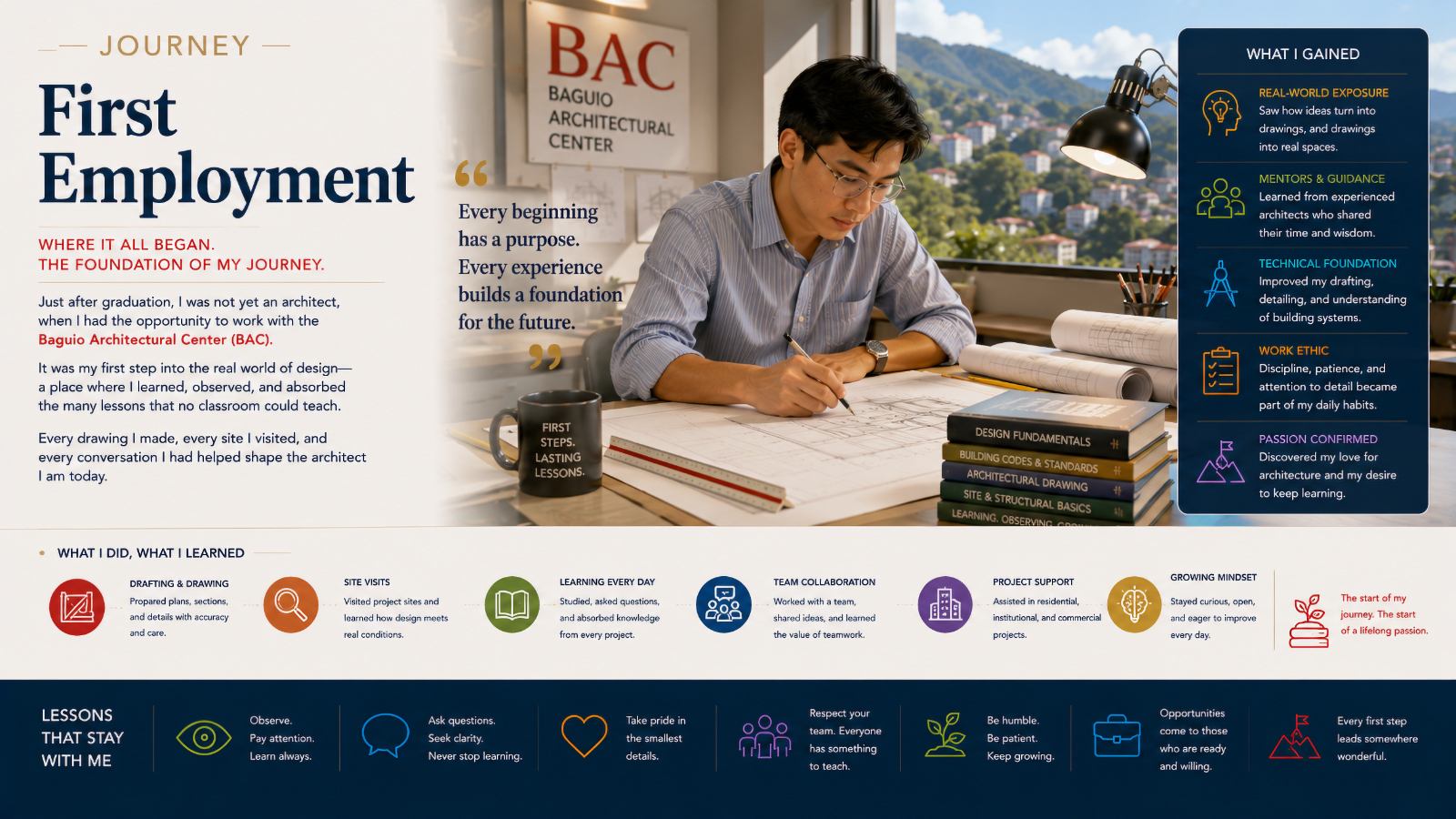
There is a saying that everyone remembers their first job. Mine began shortly after graduating from architecture school, when I joined Baguio Architectural Center (BAC) as a young employee. I was eager to learn, full of enthusiasm, and not yet a licensed architect. Looking back after nearly five decades in the profession, I realize how fortunate I was to begin my career under the guidance of a mentor who taught lessons that extended far beyond architecture.
My First Architectural Job at Baguio Architectural Center
From June 1973 to around July 1974, I had the privilege of working at Baguio Architectural Center (BAC). Our office occupied a suite on the third floor of the Antipolo Building along Session Road, just below the grounds of the Baguio Cathedral. Even today, the building remains one of the city's most sought-after office locations.
The firm was headed by Architect Ferdinand Hamada, whom I still fondly call Boss Nanding. Although he has lived in the United States since the 1980s, we have remained in touch through Facebook. Nearly fifty years later, I continue to look back on those formative days with deep appreciation, grateful for the guidance and experience that helped shape the architect I would become.
Learning Architecture Through Real Projects
My official—though unofficial—designation was designer and estimator, a considerable responsibility for someone fresh out of university. Despite my limited practical experience, Boss Nanding entrusted me with preparing conceptual and schematic designs for several proposed projects, ranging from residential renovations to a sizeable commercial development that, unfortunately, was never awarded to our firm.
Those early assignments taught me a lesson that every young architect eventually learns: confidence is built through experience. Every drawing, revision, cost estimate, and client presentation became an opportunity to develop practical skills that no classroom could ever fully teach.
Looking back, I realized that architecture is learned not only from textbooks but also through real clients, real budgets, real deadlines—and the trust that others place in you before you have fully learned to trust yourself.
The Estimating Lesson I Never Forgot
One assignment, in particular, left a lasting impression on me.
I was paired with another employee, Lito Ballesteros, to prepare the firm's cost estimate for what I recall was the proposed Gorostiza Subdivision Project. Together, we painstakingly compiled quantity takeoffs and unit costs, relying on the estimating tables and cost data we had personally assembled.
When the bidding results were announced, Boss Nanding informed us that our proposal had turned out to be the highest submitted.
Although disappointing at the time, the experience became one of my earliest and most valuable lessons in construction economics. I came to understand that accurate estimating is far more than an exercise in arithmetic. It demands current market knowledge, reliable cost data, sound judgment, and an appreciation of the competitive realities of the construction industry. Even the finest design cannot succeed if its cost places it beyond a client's reach.
That lesson stayed with me throughout my career. When I later established RG Chan & Associates, accurate budgeting and realistic cost planning became fundamental to every project we undertook.
Professional Habits That Shaped My Career
Looking back, the greatest lessons I learned from Boss Nanding were not technical.
They were lessons in professionalism.
- He taught by example that the way we present ourselves reflects the respect we have for our clients. Dressing appropriately was never about appearance alone—it was about professionalism and consideration for others.
- He also impressed upon us the importance of punctuality, often reminding the staff that arriving on time is one of the simplest yet most meaningful demonstrations of professional respect.
- Just as important was the way he communicated with clients. He presented ideas with clarity, confidence, and sincerity, teaching us that an architect's role extends beyond design. Clients must not only understand our ideas—they must also have confidence in the people presenting them.
- Above all, he demonstrated that every client, contractor, consultant, and employee deserves to be treated with courtesy, fairness, and respect, regardless of position or circumstance.
Those principles have remained with me throughout my career and continue to guide every professional relationship I build today. When I established RG Chan & Associates, they became part of the culture I sought to cultivate within our practice.
I have often reflected on where Boss Nanding's remarkable professionalism came from. Perhaps his Japanese heritage helped shape values such as discipline, courtesy, and respect, but whatever their source, he embodied them consistently. His example left a lasting impression on me, one that has endured throughout my professional life.
The Foundation of a Lifetime in Architecture
When I joined Baguio Architectural Center (BAC), I believed I was simply accepting my first job.
Only years later did I realize that I was laying the foundation for everything that would follow.
The technical skills I acquired would continue to evolve through computer-aided design (CAD), Building Information Modeling (BIM), project management, and nearly five decades of professional practice. Yet the values I learned during that first year—discipline, humility, confidence, punctuality, professionalism, and respect—have remained constant throughout my career.
For that reason, I will always look back on my time at Baguio Architectural Center with gratitude. It was there that I discovered that a successful architectural career is measured not only by the buildings we design, but also by the values we carry with us throughout our lives. I could not have asked for a better place to begin that journey.